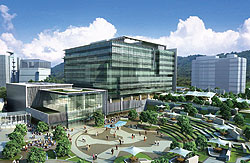
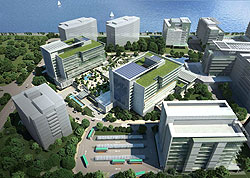
Hong Kong Science Park Phase 3, the new addition to Hong Kong Science Park, will encompass a total site area of 6.24 hectares. Of the 105,000 square metres of total gross floor area available, R&D offices will account for about 85% with laboratories and ancillary supporting services in the development mix. Phase 3 is anticipated to accommodate an additional 150 companies, and will in due course become home to some 4,000 scientists, engineers and technicians. What is more, around 5,000 construction jobs will be created. In addition, the development will contribute approximately HK$5.35 billion to Hong Kong¡¯s GDP from 2014 to 2019, and HK$1.9 billion per year from 2020 onwards.
Hong Kong Science Park Phase 3 will embrace a host of green features. In addition to 14 core sustainable technologies to be employed, including both active and passive design features, it is worth noting that all buildings in the development are targeted to meet the strict Hong Kong Building Environmental Assessment Method (HKBEAM) Plus Platinum standard, and at least one building will target the Leadership in Energy and Environmental Design (LEED) Platinum standard, which is a world recognised green rating system and presently the highest level of certification available, thus underscoring the Park¡¯s commitment to adopting and promoting green technologies.
Project objectives
- To accomplish HKSTPC¡¯s vision being a role model in promot ing and implement ing green sustainable construct ion and development in Hong Kong
- To plan and develop Phase 3 into a sustainable development that incorporates the latest pract ical green technologies and sustainable building design
- To evolve Phase 3 into the catalyst to develop Hong Kong and Pearl River Delta Region as the hub for clean-tech
- Target ing net zero carbon in the long-run with due considerat ion of cost-effect iveness and road-mapping
Sustainable master plan
Targeted to be the regional hub of green technologies, Phase 3 aims to be carbon neutral in the long run. The emphasis is on the master concept of sustainability with three key design principles¨Creduction, efficiency and generation. Contrary to general belief, the key to achieving sustainability lies in the more cost-effective means of reduction in energy demand and attaining energy efficiency, rather than generat ing energy through renewable sources.
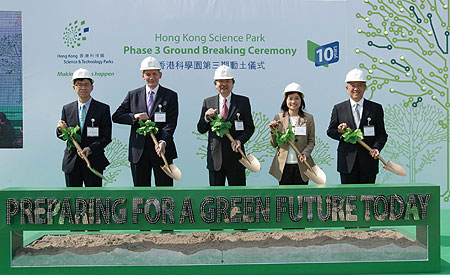
The highly anticipated ground breaking ceremony to usher in construction of Hong Kong Science Park Phase 3 was conducted on 15 December 2011. Serving as the Guest of Honour at the groundbreaking ceremony was Mr John C Tsang, Financial Secretary, HKSAR. Other officiating guests included Mr Andrew Lai, Deputy Commissioner for Innovation and Technology, HKSAR; and Mr Nicholas Brooke and Mr E Anthony Tan, Chairman and Chief Executive Officer respectively, HKSTPC. Gammon Construction is the main contractor for the project.