|
|||
| HONG KONG | <Search <Archives <eBulletin Next> | ||

April 19, 2026 Medium-Term Outlook for Hong Kong Construction (2026-2028) The construction market in Hong Kong underwent a noticeable shift from 2024 to 2025, moving from a period of strong cost inflation into one of stabilization. In 2024, construction costs peaked due to a combination of labour shortages, high material prices, and strong project demand, making Hong Kong one of the most expensive construction markets globally. By 2025, however, weaker property market conditions, slower project pipelines, and easing supply chain pressures led to a plateau in costs. Despite this moderation, Hong Kong remains structurally expensive due to persistent constraints such as limited labour supply, dense urban conditions, and complex regulatory processes. Looking ahead to the next three years, construction costs in Hong Kong are expected to rise moderately at around 2–4% annually. Growth in the sector will likely be supported by public infrastructure and housing projects, although private sector activity may remain subdued. Structural challenges—particularly labour shortages and inefficiencies—will continue to keep costs elevated, even in periods of softer demand. As a result, Hong Kong is expected to maintain its position as a high-cost, high-quality construction market rather than returning to rapid cost escalation.
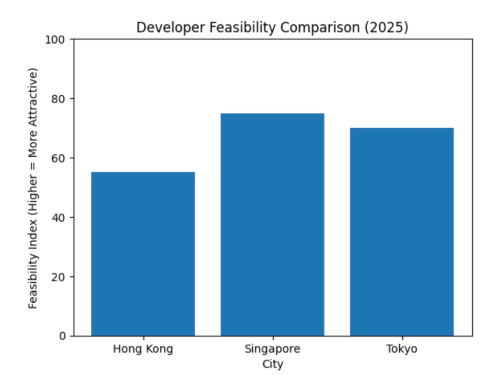 When compared with Singapore and Tokyo, Hong Kong stands out as the most expensive but not necessarily the most efficient market. Singapore offers a more balanced environment, with slightly lower construction costs, stronger regulatory coordination, and more predictable development conditions, making it the most favorable for developers overall. Tokyo, while also a high-cost city, benefits from superior construction productivity and mature supply chains, which help offset its expenses and create a stable development environment. In contrast, Hong Kong’s high costs and market volatility reduce development feasibility, limiting opportunities primarily to well-capitalized developers.
Overall, while Hong Kong remains a premium construction market, its relative competitiveness is challenged by structural inefficiencies. Singapore emerges as the most developer-friendly city among the three, while Tokyo offers stability and efficiency. Hong Kong, though still attractive in select cases, presents higher risks and tighter margins in the current environment. (Reported by Building.hk)
 (WKCDA)
|
|



|