|
|||
| HONG KONG | <Search <Archives <eBulletin | ||

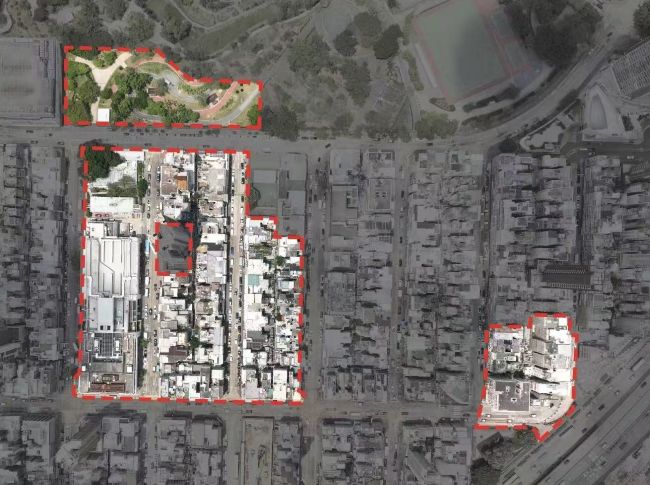
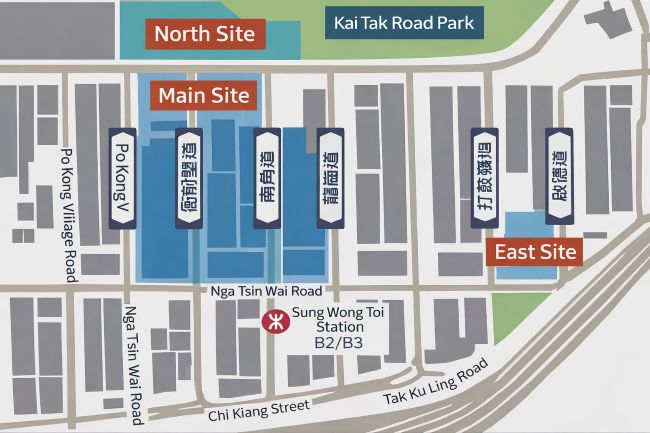
January 19, 2026 Kowloon City Urban Renewal Project The Urban Renewal Authority (URA) has initiated a series of large-scale redevelopment projects in Kowloon City, covering areas along Nga Tsin Wai Road, Ka Tak Road, and Chi Kiang Street. The projects comprise a Main Site, Northern Site, and Eastern Site, and are being implemented under a district-based redevelopment approach (District-led Development). As planning details become more defined and selected sites progress into the tendering stage, market attention has increasingly focused on project phasing, development risks, financial viability, and long-term urban impact.
This article provides an overview of the planning strategy, latest tender developments, and professional estimates of investment scale, development timeframe, and post-completion population capacity.
Planning Strategy: A District-Based Urban Regeneration Model
Unlike traditional single-lot redevelopment, the Kowloon City Urban Renewal Project adopts a comprehensive district redevelopment model, integrating multiple sites, infrastructure upgrades, and community facilities into a coordinated urban transformation.
Key planning components include:
- High-density residential developments with retail and ancillary commercial uses
- Reprovisioning and upgrading of public open space and parks
- Improvement of pedestrian connectivity and road networks
- Development of public facilities, including markets, social welfare services, and government offices
- Preservation and enhancement of local cultural and streetscape characteristics
The Northern Site is planned to accommodate public and government-related facilities, acting as a civic anchor for the district, while the Main Site and Eastern Site will primarily support residential-led mixed-use developments.
 Tendering Progress and Market Response
Ka Tak Road / Chi Kiang Street Project (KC-015)
The KC-015 project, located toward the eastern portion of the redevelopment area, encountered significant challenges during its recent tender exercise:
- Only one tender submission was received
- The submission did not fully comply with the tender requirements
- URA decided not to award the contract and suspended the tender process
The Authority is currently reassessing development strategies, which may include phased implementation, increased direct development participation by URA, or re-tendering once market conditions improve.
Introduction of the Development Facilitation Service
In response to subdued market sentiment and increased tender risks, URA has introduced a Development Facilitation Service prior to formal tender launches.
This mechanism aims to:
- Provide earlier and more transparent project information to potential bidders
- Facilitate structured engagement with developers and consultants
- Reduce the likelihood of non-compliant tenders
- Improve overall tender success rates for complex large-scale projects
- This approach is expected to be applied to upcoming Kowloon City sites.
Estimated Investment Scale
Based on the overall site area, assumed plot ratios, and recent URA project benchmarks, the total capital investment required for the Kowloon City Urban Renewal Project is estimated at: HKD 45–60 billion (approx)
This includes:
- Land resumption and compensation
- Construction of residential, commercial, and public facilities
- Infrastructure, streetscape, and open space works
- Professional fees, financing, and administrative costs
The project represents one of the largest district-based urban renewal investments currently planned in Kowloon.
 Estimated Development Programme
Given the scale and complexity of land acquisition and phased implementation, the overall development timeframe is estimated to be: Approximately 12–18 years, with a conservative scenario extending to around 20 years.
Key phases include:
- Land acquisition and site clearance
- Tendering and development structuring
- Construction of residential blocks and public facilities
- Completion of infrastructure and public realm works
Post-Completion Residential Capacity
Based on assumed residential proportions and typical unit sizes, the completed development is expected to provide:
- Approximately 3,250–7,000 residential units
- Most likely outcome: around 4,900 units
- This would accommodate an estimated:
- 7,800–22,400 residents,
- With a most probable population of about 13,300 people
These figures will be refined as detailed planning parameters and unit mixes are finalised.
Conclusion
The Kowloon City Urban Renewal Project is a long-term, district-wide transformation rather than a single-site redevelopment. With an estimated investment of up to HKD 60 billion and a development timeframe of up to 20 years, the project will substantially reshape the built environment of central Kowloon.
Although tendering has been affected by current market conditions, improved developer engagement, government support, and flexible phasing are expected to enhance project deliverability. Upon completion, the redevelopment will deliver significant new housing, upgraded public facilities, and better connectivity, strengthening Kowloon City’s role as a key urban district adjacent to the Kai Tak Development Area. (Reported by Building.hk)
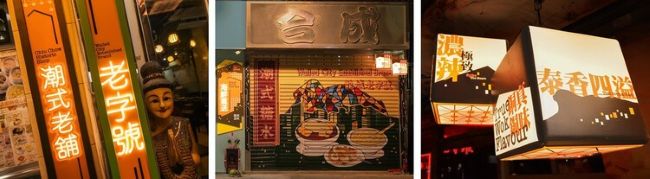 (URA)
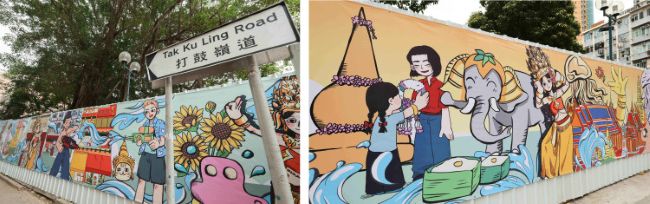 Public art and streetscape enhancement works by the Urban Renewal Authority (URA) along Tak Ku Ling Road, Kowloon City, featuring community-themed murals that celebrate local culture and history as part of the district’s revitalisation programme.
|
|


|