|
|||
| HONG KONG | <Search <Archives <eBulletin Next> | ||

December 22, 2025 MTR Begins Planning Work for South Island Line (West) The Hong Kong Government has formally invited the MTR Corporation to commence detailed planning and design for the South Island Line (West) (SIL(W)), marking a significant step forward in the long‑anticipated expansion of the city’s railway network. The project represents a strategic investment in transport resilience, urban connectivity, and long‑term district redevelopment across the southern and western corridors of Hong Kong Island.
Project Scope and Alignment
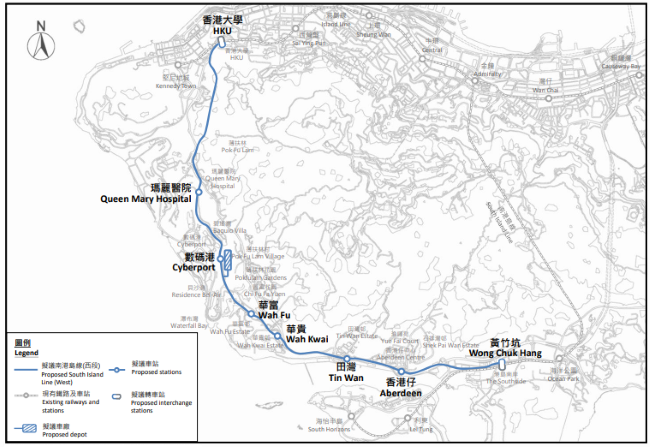
According to government and MTR announcements, the SIL(W) will adopt a “smart and green” mass‑transit system, operating along a dedicated 7.5‑kilometre alignment comprising a combination of elevated viaducts and tunnel sections. The line will include eight stations—Wong Chuk Hang, Aberdeen, Tin Wan, Wah Kwai, Wah Fu, Cyberport, Queen Mary Hospital, and HKU—together with a depot near the future Cyberport Station.
The alignment is designed to serve approximately 130,000 residents and major institutional nodes such as Queen Mary Hospital and Cyberport, providing a reliable feeder connection to the existing South Island Line (East) and the Island Line. Upon completion, the SIL(W) will form a loop with these two lines, enhancing network redundancy and improving operational resilience across Hong Kong Island’s rail system.
 Engineering Considerations and System Selection
One of the defining features of the SIL(W) is the decision to adopt a lighter, dedicated mass‑transit system rather than a conventional heavy‑rail solution. Government analysis indicates that the hilly topography—particularly the more than 60‑metre elevation difference between Wah Fu Estate and the Aberdeen Promenade—would have required deep tunnelling under a heavy‑rail scheme, resulting in lower transport benefits and poor cost‑effectiveness.
By contrast, the selected system allows for a combination of elevated structures and shallower tunnels, reducing construction complexity and environmental impact. Government estimates suggest that this approach will lower construction costs by approximately 40% and advance the delivery programme by about two years compared with the original heavy‑rail proposal.
For construction professionals, this shift underscores a broader trend in Hong Kong’s rail development: the adoption of more flexible, context‑responsive transit technologies to address challenging terrain, cost constraints, and community interface issues.
Programme, Phasing, and Integration with Redevelopment
The Government has indicated that advance works are targeted to begin in 2027, with full completion expected by 2034. This timeline is closely aligned with major district‑level initiatives, including the redevelopment of Wah Fu Estate, which will rely heavily on improved transport accessibility to support population intake and long‑term community planning.
The project’s interface with dense residential areas, hospitals, schools, and waterfront districts will require careful staging, stakeholder engagement, and mitigation planning. MTR has stated that it will maintain close communication with affected communities to refine alignment and construction approaches that balance engineering feasibility with neighbourhood needs.
Implications for the Construction and Engineering Sector
The SIL(W) represents one of the most technically and logistically complex rail projects currently advancing in Hong Kong. Key areas of professional interest include:
- Hybrid elevated–tunnel design to navigate steep terrain and built‑up districts
- Smart and green transit technologies, potentially including automated operations
- Depot integration within a constrained urban footprint
- Construction staging near hospitals, schools, and major residential clusters
- Network resilience enhancements through loop formation with existing lines
- Cost‑optimised delivery models compared with traditional heavy‑rail schemes
As Hong Kong continues to pursue sustainable transport expansion, the SIL(W) will serve as a benchmark for how alternative rail technologies can be deployed to meet urban, topographical, and financial constraints.(Reported by Building.hk)
 |
|



|