 < Main Page
Free Trade Agreements and Economic Cooperation Lay the Foundation for Sustainable Growth Across Southeast Asia
The Association of Southeast Asian Nations (ASEAN) has emerged as one of the world's most dynamic economic regions, combining a market of nearly 700 million people with a collective economy approaching US$4 trillion. Over the past decade, ASEAN governments have steadily reduced trade barriers, improved investment frameworks and strengthened regional connectivity, creating a more integrated marketplace for businesses and investors. As global manufacturers diversify supply chains and seek new growth opportunities, ASEAN's economic integration is becoming a major driver of trade, industrial development and cross-border investment.
Key Trade Agreements Driving ASEAN Integration
The foundation of ASEAN's economic success rests on a series of trade and investment agreements designed to facilitate the movement of goods, services and capital across member states.
The ASEAN Trade in Goods Agreement (ATIGA) remains the cornerstone of regional trade liberalisation. Through ATIGA, tariffs on the vast majority of goods traded within ASEAN have been reduced to zero, significantly lowering costs for businesses and encouraging the development of regional supply chains.
Complementing ATIGA is the ASEAN Trade in Services Agreement (ATISA), which seeks to open markets for service providers in sectors such as construction, engineering, architecture, logistics, finance and professional consultancy. The agreement enables companies to expand their operations more easily across ASEAN markets while supporting greater mobility of expertise and investment.
The ASEAN Comprehensive Investment Agreement (ACIA) provides an additional layer of protection for investors by enhancing transparency, improving market access and promoting fair treatment for foreign investments within the region. The agreement has helped boost investor confidence and encouraged long-term capital commitments.
Beyond its internal frameworks, ASEAN is also a key participant in the Regional Comprehensive Economic Partnership (RCEP), which links the bloc with China, Japan, South Korea, Australia and New Zealand. As the world's largest free trade agreement, RCEP has further strengthened ASEAN's position as a strategic hub within regional and global supply chains.
Benefits for ASEAN Member States
The advantages of ASEAN integration extend well beyond tariff reductions. A more connected regional market allows manufacturers to source components from multiple countries while enjoying preferential trade treatment. This flexibility has helped ASEAN establish highly competitive production networks in sectors such as electronics, automotive manufacturing, machinery and consumer goods.
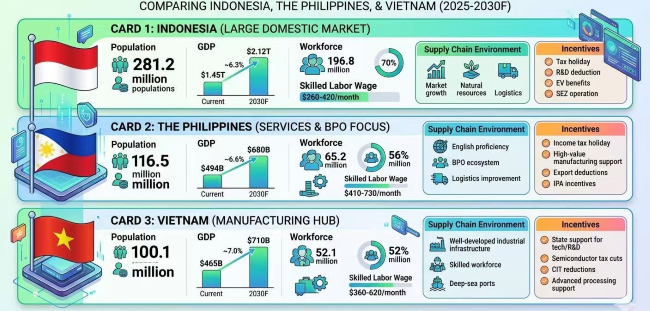
Economic integration has also enhanced the region's attractiveness to foreign investors. Multinational corporations increasingly view ASEAN as a strategic production base that offers access to a large consumer market while providing manufacturing diversification opportunities. Countries such as Vietnam, Indonesia, Thailand, Malaysia and the Philippines have benefited significantly from these investment flows.
In addition, deeper regional cooperation is supporting the development of transportation infrastructure, industrial parks, logistics corridors and digital networks that facilitate trade and improve economic efficiency throughout Southeast Asia.
Outlook
ASEAN's trade agreements and economic cooperation frameworks have created a strong foundation for future growth. As regional integration continues to deepen, member states are expected to benefit from increased trade, stronger industrial capabilities and greater investment inflows.
For businesses involved in construction, manufacturing, building materials and infrastructure development, understanding ASEAN's evolving trade architecture is becoming increasingly important. The agreements that have transformed ASEAN into a more integrated economic community are also laying the groundwork for the next phase of regional expansion, investment and industrial development.
(Reported by Building.hk)