|
|||
| Products & Services | <Search <Archives <eBulletin Next> | ||

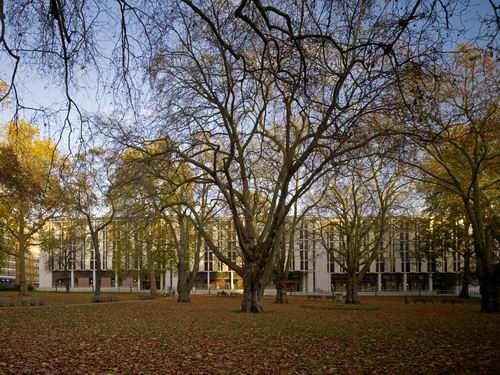
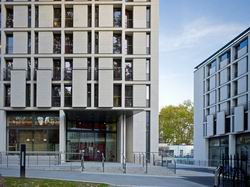
March 22, 2010 KPF's design of the Eastside building at Imperial College, London Imperial College, London is a science-based institution frequently ranked amongst the world’s top universities. Based on eight sites within the capital, the college currently has more than 13,000 students from 158 countries studying more than 200 taught courses.
The college undertakes a large number of construction projects of varying scales to ensure that its facilities are in line with the world class standard of its teaching and research.
The construction of the Eastside building completes the master plan for upgrading the college’s residential accommodation provision in South Kensington. Previous projects included the building of the Southside halls of residence, the Mews residences as well as upgrading Prince’s Gardens square and surrounding roads. The Eastside building has replaced Linstead Hall which was completed in 1967 and subsequently extended in 1980. In 2002 a decision was taken to redevelop both the south and east sides of Prince’s Gardens. The Southside hall was completed in October 2007 with the Eastside some two years later.
KPF’s design of the Eastside building (and of the earlier Southside development) is driven by the critical factors identified by the master plan prepared in 2003, alongside the need to satisfy the client’s brief. The practice identified a number of key objectives of the master plan which have underpinned the approach to the scheme.
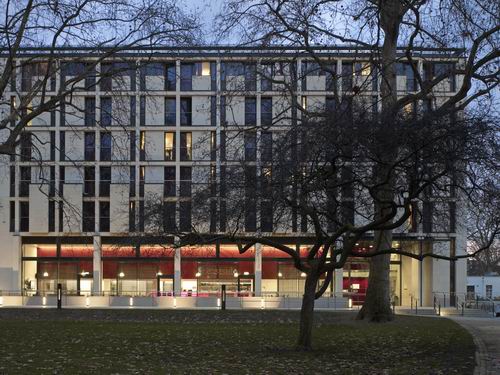
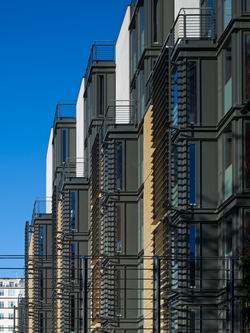
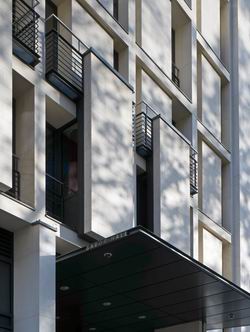
A primary aim was to restore the original massing of the terraces around Prince’s Gardens. In order to do so, the new building is two storeys (approximately 6 metres) lower than Linstead Hall whilst still providing greater capacity for student accommodation in accordance with Imperial College’s requirements. The elevational treatment varies depending on the context: the front elevations are of limestone and are relatively flat in keeping with the 19th century terraces within the Knightsbridge Conservation Area. The rear elevations are arranged in stepped bays and constructed from brick and stucco, designed to correspond more closely to the terraced houses and mews streets.
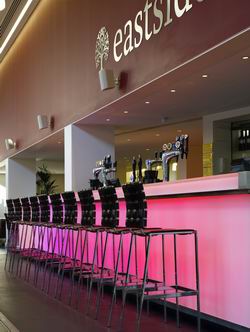
The new Eastside building is divided vertically, to provide three new student halls, each providing accommodation for approximately 150 students. The ground floor of the building provides public communal facilities including a convenience store and cafe bar as well as common rooms for use by residents.
The residential accommodation – at basement, lower ground, ground and six upper floors – is organised into ‘clusters’ of rooms gathered around a daylit central hall. Twenty four students are housed on each floor of each hall sharing spacious and well-lit communal spaces for food preparation, dining and socialising. These spaces are designed to be bright and airy with full height windows to the south. (Photos by Tim Soar)
    |
|

Copyright © Building.hk All rights reserved.
|